


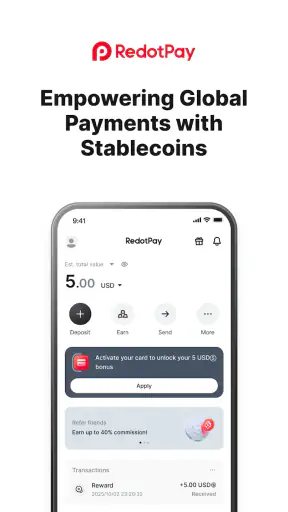
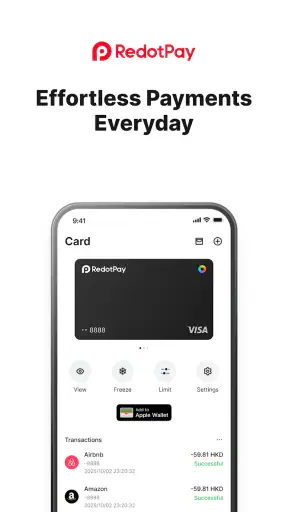
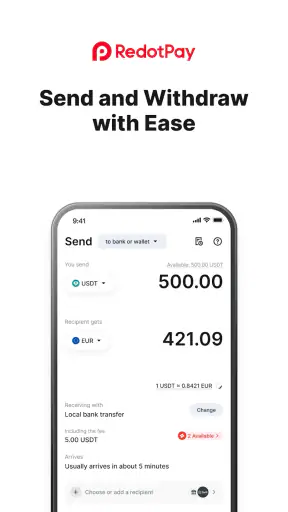
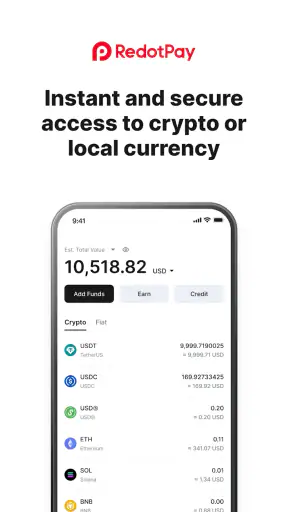
I approached RedotPay as a practical finance app rather than just another crypto wallet. Its central promise is simple: it aims to make digital assets usable for everyday spending, with tools for holding, swapping, sending, and paying. That focus matters because many crypto apps are comfortable for watching balances but awkward when you actually need to move value or use it outside the crypto ecosystem.
Developed by Red Dot Technology Limited, this free finance app is available to users rated Everyone and supports Android versions starting with 7.0. It has reached over 5 million installs, with a 4.4 average from around 73 thousand ratings and roughly 1.3 thousand written reviews. Those figures suggest that it has moved beyond being a niche experiment, although popularity alone does not remove the need to understand how it fits your own spending habits.
My review centers on the most important capability here: using crypto more like spendable money. The useful question is not whether the app contains a wallet, because many apps do. The better question is whether RedotPay can reduce the gap between holding crypto and using it for a real purchase without making the process feel unnecessarily complicated.
Turning a crypto balance into a spending tool
The capability that changes the experience
A conventional crypto wallet is mainly designed around addresses, networks, confirmations, and transfers. That is appropriate when your goal is to manage blockchain assets directly, but it can feel distant from normal shopping. RedotPay takes a more payment-oriented approach by combining wallet functions with the idea of spending crypto worldwide. In practical terms, the app is built for someone who wants one place to keep digital assets and then use them as part of an ordinary payment routine.
The distinction is important. A wallet can be excellent at receiving and sending tokens while still being inconvenient at the checkout counter. A crypto payment product tries to make the final step less technical. For me, that is the reason to consider this app, not simply the presence of the words “wallet” or “swap” in its feature set.
The app also brings sending and swapping into the same general workflow. That can be useful when the asset you hold is not the one you want to use. Instead of treating storage, conversion, and spending as completely separate activities, RedotPay presents them as connected parts of a broader money-management experience.
That convenience comes with a responsibility: I would not treat the app as a magic conversion layer that makes crypto identical to cash. The underlying value can still change, and the exact result of a transaction depends on the asset, conversion step, and payment circumstances. Its strength is reducing friction, not removing financial risk.
What the wallet-and-spend combination means
The wallet side gives you a place to manage digital assets, while the spending side gives those assets a more immediate purpose. This is especially relevant for people who receive crypto, hold it temporarily, or use it across countries and want something closer to a payment routine than a purely investment dashboard.
I find this approach more approachable than a wallet that expects every user to understand blockchain mechanics before making a purchase. However, the app is still a crypto finance product. New users should expect to learn the difference between holding an asset, swapping it, sending it, and spending it. Those actions may look similar from a distance, but they are not interchangeable.
A useful habit is to decide what role the app will play before adding money. If it is a spending wallet, keep the balance aligned with near-term use. If it is a transfer tool, focus on the reliability of your sending workflow. If it is a place to swap assets, pay close attention to the result shown before confirming. This simple separation prevents the app from becoming an unstructured collection of crypto actions.
How I would use it before making a purchase
I would begin by checking the available balance and deciding which asset is intended for spending. If a swap is necessary, I would review the conversion details carefully rather than assuming that the displayed amount is the same as the final value I have in mind. Then I would confirm that the payment method is ready before relying on it for an important purchase.
That preparation is one of the less obvious lessons with a product like this. The smoothest payment experience usually happens before you reach the checkout. A few moments spent checking the asset, balance, and intended transaction can prevent the most common kind of frustration: discovering at the point of payment that the wrong balance is available or that a conversion is still required.
I would also keep a separate backup payment method. That is not a criticism unique to RedotPay; it is sensible for any crypto-based spending arrangement. A merchant, network, conversion step, or account check can introduce uncertainty that does not exist with a normal bank card. The app can be useful without being the only way I carry money.
A realistic everyday scenario
Imagine that I am traveling and have crypto available, but I do not want to move it through several unrelated services before paying for a meal or a small purchase. RedotPay’s appeal is that it brings the balance and spending purpose closer together. I can think of the app as a bridge between my digital assets and a normal payment moment, rather than opening a trading platform, moving funds to another wallet, converting them elsewhere, and then searching for a separate payment solution.
The benefit is not just fewer app switches. It is also fewer opportunities to lose track of which balance is where. When money passes through several services, it becomes harder to understand the full path from the original asset to the final purchase. A unified workflow can make that path easier to follow.
Still, I would prepare before traveling. I would not wait until a busy checkout to learn how swapping and spending interact. I would test the basic flow with a modest amount, confirm that I understand the screens, and keep an alternative payment option available. That is the difference between using the app deliberately and treating it as an emergency substitute for a bank account.
Where sending and swapping fit
Sending is useful when another person or service needs crypto directly. Swapping is useful when the asset you hold is not the asset you want to retain or spend. Their presence alongside the wallet means RedotPay can serve more than one moment in the same financial routine.
The trade-off is that each additional action creates another point where a mistake can happen. Sending requires careful attention to the destination and asset. Swapping requires attention to what you are exchanging and what you will receive. Spending requires attention to the payment itself. I would never rush through these steps simply because they appear inside one app.
One practical tip is to treat the transaction screen as a checkpoint, not a formality. Before confirming, I would read the asset names, destination details, and final amount. This is particularly important when I am moving value for someone else or preparing funds for a time-sensitive purchase. The app’s unified design may feel convenient, but convenience should not become automatic tapping.
How it compares with familiar alternatives
Compared with a standard bank or card app, RedotPay is more directly connected to crypto ownership and conversion. A traditional financial app is usually easier for predictable local spending, recurring payments, budgeting, and understanding the amount in familiar currency. If my main need were ordinary household expenses, I would still prefer a conventional bank card as the primary tool.
Compared with a basic crypto wallet, RedotPay is more appealing when I want an end use beyond holding and transferring assets. A basic wallet may offer a clearer blockchain-first experience, especially for users who want direct control over addresses and networks. RedotPay makes more sense when the goal is to connect a crypto balance to payment behavior.
Compared with a crypto exchange, its advantage is the spending orientation. Exchanges are often better suited to market activity and asset selection, while RedotPay is more relevant when I want to move from holding to using. The right choice depends on the job: trading-focused users may prefer an exchange, long-term self-custody users may prefer a dedicated wallet, and practical spenders may find the RedotPay model more natural.
I would not choose it simply because it combines several functions. Combining functions is helpful only when the workflow remains understandable. The app is strongest for users who value a connected path from crypto balance to payment, not for someone seeking the most specialized tool in every individual category.
The friction behind the convenience
The first limitation is conceptual rather than visual: crypto spending is not as predictable as spending money already held in a familiar cash balance. Asset values can move, and swapping introduces an extra decision before payment. Even if the app makes the process feel straightforward, I still need to think about timing and value.
The second limitation is that a single app can encourage overconfidence. Because the wallet, swap, send, and spend functions sit close together, it may be tempting to assume that every transaction is equally simple. They are not. Users who are uncomfortable checking addresses, assets, and conversion results may find a regular card more reassuring.
The third limitation concerns suitability. I would hesitate to recommend RedotPay as the only financial tool for someone who needs strict budgeting, predictable balances, or conventional banking features. It is better viewed as a crypto spending companion than as a complete replacement for everyday financial infrastructure.
There is also a learning curve for people who have never used crypto. The app may make the experience more approachable, but it cannot change the underlying concepts. A beginner still needs to understand what they are holding and what action they are authorizing. I would start with a small, manageable balance and avoid using it for an important payment until the workflow feels familiar.
Security habits matter more than the interface
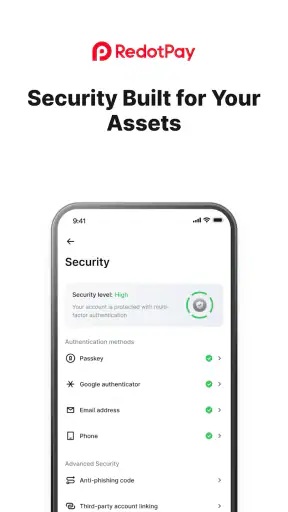
The app describes itself as a secure wallet, but I would still judge security by my own habits as much as by the interface. I would use a strong, unique account password, protect the phone itself, and avoid treating a payment app as a place to store more value than I need for its intended purpose.
I would also be cautious with messages that ask me to reveal account details or approve an unexpected action. A polished finance app cannot protect a user who willingly gives away access information. The safest workflow is deliberate: open the app directly, inspect the transaction, and confirm only what I recognize.
Another useful discipline is keeping records of meaningful transfers and swaps. This helps me understand where funds went and makes it easier to notice an unfamiliar activity. It is especially valuable when the app is used for travel or irregular spending, because those situations can make transactions harder to remember later.
Who benefits most from the spending model
RedotPay is most attractive to crypto users who want a practical use for their holdings. That includes people who regularly move between assets, send crypto to others, or travel and want a payment-oriented way to access digital funds. The app is also a reasonable starting point for someone who finds a pure blockchain wallet too technical but still wants to explore crypto spending.
It may also suit users who dislike juggling a separate wallet, exchange, and payment service. Reducing the number of places involved can make a personal workflow easier to remember. The real gain is organizational: one app can provide a clearer route from asset management to use.
On the other hand, I would point a cautious beginner toward a conventional card if their priority is stable spending and simple budgeting. I would point an advanced self-custody user toward a dedicated wallet if direct blockchain control is more important than payment convenience. I would point an active trader toward a specialized exchange if market tools are the main requirement.
What I would check before committing
Before making RedotPay part of my routine, I would answer a few practical questions through hands-on testing. Can I identify the spending balance quickly? Do I understand the swap result before confirming? Can I complete a small send without hesitation? Do I know which payment method I will use if the crypto route is unavailable?
I would also test the app during a low-pressure moment rather than during travel or at a crowded checkout. That reveals whether the interface suits me without adding the stress of a real purchase. If I need to consult help material for every basic action, the product may not be the right fit even if its feature set looks attractive.
Because the app is free, the decision is less about an upfront purchase and more about whether its crypto-centered workflow matches my needs. Free access does not make every transaction consequence-free, so I would still evaluate the app based on clarity, control, and how comfortable I feel checking each action.
My final take on using crypto like cash
RedotPay succeeds when I judge it as a bridge between crypto ownership and everyday spending. Its wallet, swap, send, and payment-oriented design gives digital assets a more practical role than simply sitting in an account. The strongest use case is someone who already has a reason to hold crypto and wants a less fragmented route to using it.
I would recommend it to a friend who understands the basics of crypto, wants a spending-focused workflow, and is willing to keep a backup payment method. I would not recommend relying on it blindly for all expenses, nor would I choose it over a bank app for predictable household budgeting or over a specialized wallet for advanced self-custody.
The current version is 3.13.2, and the app has been available since June 9, 2023. Those details place it as an established product rather than a brand-new release, but my decision would still come down to the same practical test: whether the path from balance to payment feels clear enough for the way I actually use money.
My honest conclusion is that RedotPay is most valuable when convenience has a specific purpose. If I want to spend crypto, send it, or prepare it for use without constantly switching between unrelated services, it is worth considering. If I mainly want stable cash management, detailed budgeting, or maximum technical control, another type of finance app will likely serve me better.


